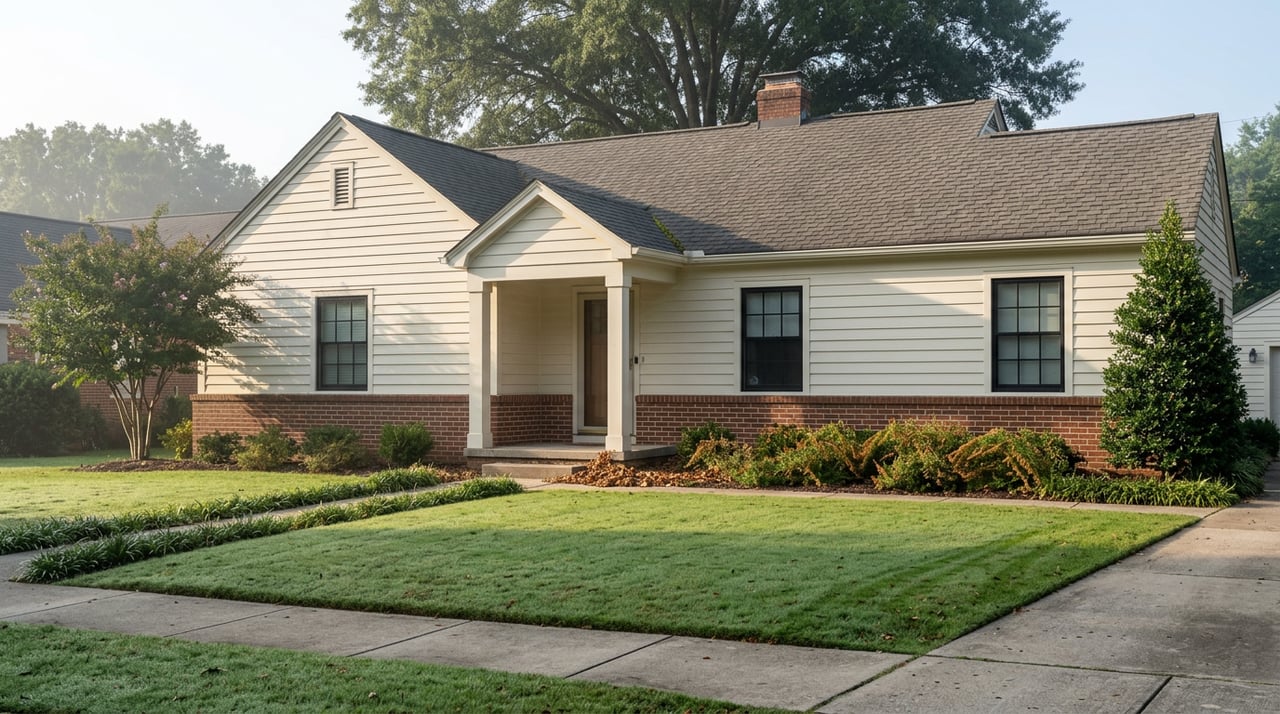
A buyer scrolling listings in Decatur sees a small brick bungalow priced well under the neighborhood's going rate and reads it as a bargain, an entry point, maybe a fixer-upper worth a weekend of paint and elbow grease. What the price tag is actually describing, more often than not, is a lot with a house standing on it that someone is about to remove.
That's not cynicism. It's the pattern the city's own planning consultant put numbers to years ago, and it's the same pattern still driving what gets built, what gets converted, and what disappears in Decatur's oldest neighborhoods.
The Study That Named What Everyone Already Suspected
In 2012, Decatur recorded 43 teardowns and 73 new homes built. The following year, that climbed to 59 teardowns and 82 new builds. Those figures came from a study by Market + Main, presented to the Decatur City Commission on Feb. 3 by principal and co-founder Aaron Fortner, and they weren't just counting demolitions. The study identified which homes were coming down: the ones valued at $200,000 or less, the segment of the market a household earning $35,000 to $45,000 a year could actually afford. In their place went new construction averaging roughly 3,000 square feet and selling around $500,000.
That data is now more than a decade old, and Decatur's prices have moved a long way since then. Over the three months ending May 2026, the median sale price for a Decatur home was $705,000, up 27.4% from the same period the year before. But the mechanism Fortner described hasn't gone away. It has just moved up the price ladder with everything else. The cheapest, oldest housing stock in the city is still the raw material for the newest, most expensive housing stock. What changed is the entry price for playing that game.
A Decatur listing under the neighborhood median isn't always a discount. Sometimes it's a countdown.
Why the City Tried to Build a Third Option
Decatur didn't always have only two speeds: modest old bungalow or 3,000-square-foot new build. Duplexes, triplexes, and small apartment buildings, the kind of housing that once absorbed young singles, artists, and seniors on a budget, were part of the city's fabric until 1988, when zoning changes shut down new construction or conversion of those building types citywide. Over the three decades that followed, through demolition or conversion to single-family homes, Decatur lost 407 of those units.
The city noticed. In 2019 the Decatur City Commission formed an Affordable Housing Task Force, and its February 2020 report recommended reintroducing what planners call missing middle housing. The recommendation became a 2023 ordinance, adopted by unanimous vote and effective June 30, 2023, that once again allows duplexes and three-to-four-unit walk-up flats in the city's R-50, R-60, R-85, and RS-17 zoning districts, provided they conform to the same size, setback, and lot-coverage rules as a single-family home. Planning and Economic Development Director Angela Threadgill described the goal plainly to Decaturish: reopen a housing type the city had written out of its own code nearly four decades earlier.
This matters for anyone comparing Decatur to other in-town Atlanta neighborhoods, because it means the city itself has publicly diagnosed the same problem a buyer runs into on the ground: the cheapest old homes keep vanishing into expensive new ones, and there was, for a long stretch, no middle rung on the ladder.
The Alternative Was Capped Almost as Soon as It Opened
Here's the part that should change how a buyer reads the market. The city didn't just legalize missing middle housing and let it run. It capped it, deliberately, during rollout. For eighteen months, from June 30, 2023 through Dec. 31, 2024, new duplex and walk-up flat permits were limited to three per lower elementary school zone, fifteen citywide during that entire window. The stated reason was to give the city time to measure the impact on parking, traffic, and school enrollment before opening the floodgates.
The three projects that came out of that early window landed in three named elementary zones: Winnona Park, Oakhurst, and Clairemont. One was a new duplex, one was a conversion of an existing single-family home, and one was a new quadplex. The City Schools of Decatur itself joined in, directing its superintendent to pursue permits to convert two school-district-owned homes, at 204 Westchester Drive and 927 S McDonough Street, into duplexes meant to house district employees as affordable rentals.
That's a genuinely small number of units for a city this size and this in-demand. The research available doesn't show what permit volume looks like now that the eighteen-month pilot window has closed, which is itself worth asking a listing agent or the city's Planning and Zoning Division about directly if a missing middle property is part of a buyer's search. What the pilot period shows clearly is intent: the city wanted a third option between "old bungalow" and "new $500K build," and it built that option slowly, on purpose, three permits at a time.
What This Means When You're Looking at a Listing
For a buyer comparing Decatur to Kirkwood, Oakhurst-adjacent Decatur to Virginia-Highland, or any in-town neighborhood already on a shortlist, the practical takeaway isn't that Decatur is overpriced or underpriced. It's that two very different products are sometimes wearing the same price tag.
Check the year built against the lot size before the square footage. A small, older home on a generous lot in a non-historic zoning district is priced closer to what the land will support once resold as a teardown, not what living in the existing structure is worth long term.
Ask whether the parcel sits inside one of Decatur's four historic districts. The MAK District, the Clairemont District, Ponce de Leon Court, and the Old Decatur District carry protections that make teardown economics much harder to execute, which changes the calculation for both buyers who want to renovate and buyers hoping to build new.
If a listing is marketed as a duplex, triplex, or walk-up flat, ask when the permit was issued. Given how few of these units exist and how tightly the city controlled early construction, a missing middle property in Decatur is not a common find, and its scarcity is itself part of the value.
Weigh the $705,000 median (three months ending May 2026) as a market-wide number, not a neighborhood-specific one. That figure reflects a mix that increasingly includes new construction replacing older stock. A buyer specifically hunting for an unrenovated older home at a discount is shopping against that same upward pull on the mix.
None of this means an older Decatur home is a bad purchase. It means the price is answering a different question than it looks like it's answering, and a buyer who knows which question is being asked negotiates from a stronger position.
A Short FAQ
Does this apply to every older home in Decatur, or just certain neighborhoods? The teardown pattern documented by Market + Main concentrated in areas outside historic district protection, where zoning allows a buyer to remove an existing structure and build to current code. Homes inside the MAK, Clairemont, Ponce de Leon Court, or Old Decatur historic districts face a different, more restrictive process.
Is missing middle housing still capped in Decatur? The formal eighteen-month pilot cap ran from June 30, 2023 through Dec. 31, 2024, limiting new duplex and walk-up flat permits to three per lower elementary school zone. What permit policy looks like now that window has closed isn't something the available research confirms, so it's worth a direct question to the city's Planning and Zoning Division for anyone specifically targeting this housing type.
If I want to buy a duplex or walk-up flat in Decatur, where do I start looking? Ask specifically whether a property was permitted under the 2023 missing middle ordinance and in which elementary school zone. Given how few units were approved during the pilot period, in named zones like Winnona Park, Oakhurst, and Clairemont, these properties don't show up in large numbers and often require some legwork to find.
Decatur's price tags are honest. They just aren't always describing the house.
If you're weighing Decatur against another in-town Atlanta neighborhood and want a read on what a specific listing's price is actually telling you, GibsonBreen can walk through the lot, the zoning, and the numbers with you. Let's Connect.